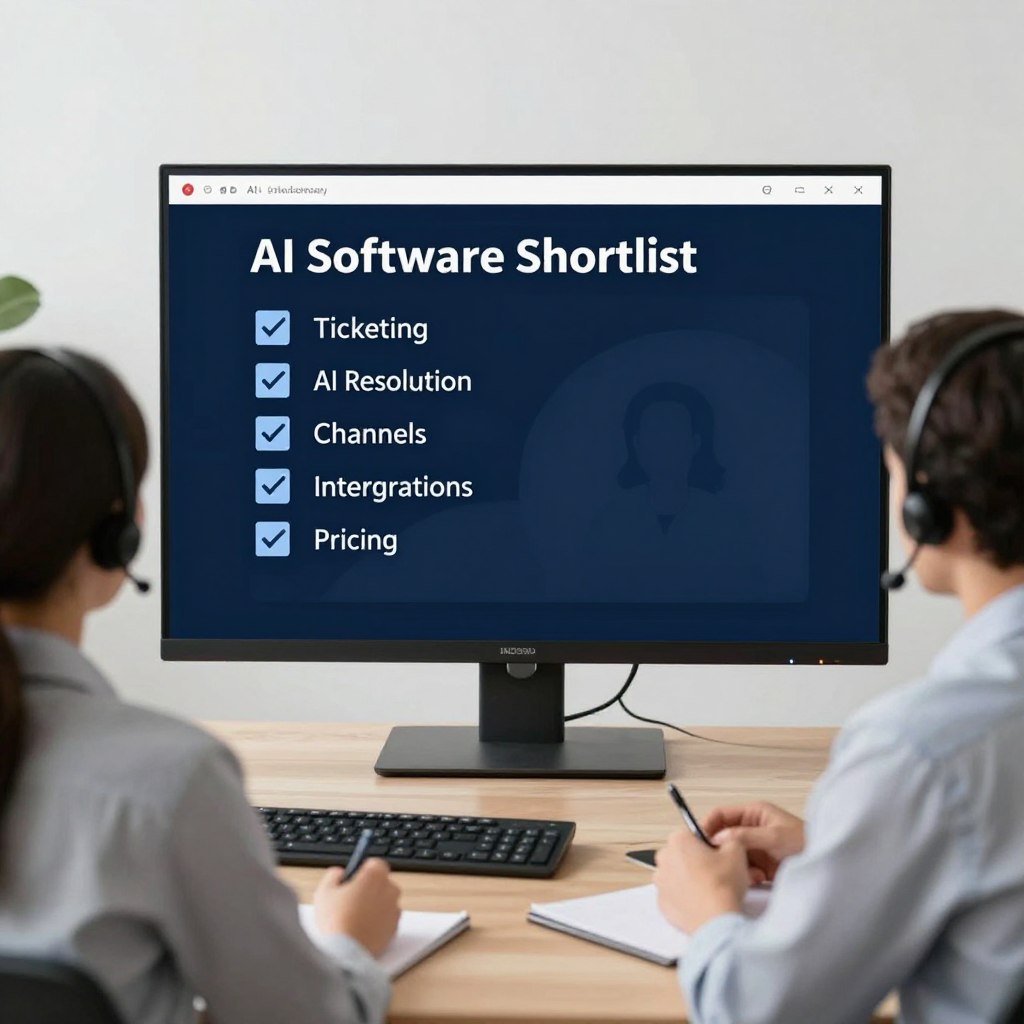

Zendesk is the best overall choice for organizations that need a mature help desk, omnichannel support, and increasingly capable AI agents in one platform. Intercom is the strongest AI-first option for SaaS and digital businesses prioritizing Fin AI Agent. Freshdesk offers a strong value path for SMB and mid-sized teams. Salesforce fits sophisticated enterprise service organizations already using Salesforce CRM. HubSpot Service Hub connects support with sales and marketing data, Gorgias is built for ecommerce operations, and Ada is aimed at large enterprises focused on highly automated customer experience.
This guide compares the best AI customer support software for United States businesses. It focuses on automated resolution, agent productivity, ticketing, knowledge management, integrations, pricing structure, governance, and implementation risk.
Best AI Customer Support Software: Quick Picks
Best overall — Zendesk
A mature help desk with broad channels, strong ticket operations, AI agents, knowledge, routing, reporting, and enterprise controls.
Best AI-first platform — Intercom
A strong fit for digital businesses that want Fin AI Agent closely connected to conversations and product support.
Best value — Freshdesk
A practical option for SMB and mid-market teams seeking customer support automation without an enterprise-first operating model.
Best enterprise platform — Salesforce
A powerful choice for complex service operations that already rely on Salesforce CRM and data structures.
Best CRM-connected support — HubSpot
A natural fit when service, sales, marketing, customer records, and reporting should share one CRM context.
Best ecommerce support — Gorgias
A focused customer service platform for ecommerce brands that need store data and service conversations together.
Best enterprise AI agent — Ada
A specialized option for organizations that prioritize automated customer experiences across complex service journeys.
Start with the right shortlist
Use the comparison below to separate mature help desk software from specialized AI agent platforms.
AI Customer Support Software Comparison
Pricing and packaging change often. Verify current U.S. pricing, included channels, AI allowances, usage charges, and contract terms on the official vendor page before purchase. A per-agent license is not directly equivalent to a per-resolution or per-conversation charge.
| Platform | Best for | Starting price | AI pricing model | Free plan | Free trial | Ticketing | Shared inbox | Live chat | Voice | SMS | Social messaging | Knowledge base | AI agent | AI copilot | Automated resolution | Workflow actions | Agent routing | SLAs | Reporting | CRM | Integrations | API | Primary limitation | ||
| Zendesk | Mature support teams | Verify current plan | Licenses plus AI usage or outcome pricing | Verify | Verify | Yes | Yes | Yes | Yes | Available by package | Available by package | Available | Available | Yes | Yes | Yes | Outcome-based measurement | Yes | Yes | Yes | Advanced options | Customer context | Marketplace | Yes | Packaging complexity |
| Intercom | SaaS and digital businesses | Verify current plan | Seats plus Fin usage or outcome terms | Usually limited or unavailable | Verify | Yes | Yes | Yes | Yes | Verify | Verify | Available by plan | Verify | Yes | Fin | Available | Fin outcome measurement | Integrations and workflows | Yes | Plan dependent | Yes | Customer records | Broad ecosystem | Yes | Less suited to every ticket-heavy operation |
| Freshdesk | SMB and mid-market teams | Verify current plan | Seats plus usage or add-on terms | Verify | Verify | Yes | Yes | Available | Yes | Package dependent | Verify | Verify | Verify | Yes | Freddy options | Yes | Verify packaging | Yes | Yes | Yes | Yes | Freshworks context | Broad options | Yes | Advanced needs may require upgrades |
| Salesforce | Complex enterprise service | Verify current plan | Licenses, credits, usage, or custom terms | No standard assumption | Verify | Yes | Available | Yes | Yes | Partner or package dependent | Partner or package dependent | Available | Available | Yes | Agentforce | Yes | Contract and usage dependent | Strong | Strong | Strong | Strong | Native Salesforce CRM | Extensive | Yes | Complex implementation |
| HubSpot | CRM-connected support | Verify current plan | Seats plus plan or usage terms | Limited tools may exist | Verify | Yes | Yes | Yes | Yes | Verify | Verify | Plan dependent | Verify | Yes | Customer agent options | Yes | Verify | Yes | Yes | Higher tiers | Yes | Native HubSpot CRM | App ecosystem | Yes | Service depth varies by tier |
| Gorgias | Ecommerce brands | Verify current plan | Seats, tickets, conversations, or AI usage | Verify | Verify | Yes | Yes | Yes | Yes | Verify | Verify | Verify | Ecommerce channels | Yes | Plan dependent | Yes | Usage dependent | Store actions | Yes | Verify | Yes | Store context | Commerce focused | Yes | Less general-purpose for complex enterprise service |
| Ada | Enterprise AI agents | Custom | Custom usage or outcome terms | No standard assumption | Verify | Often integrates | Partner or integration dependent | Yes | Verify | Verify | Verify | Verify | Verify | Yes | Core focus | Verify | Custom measurement | Integration dependent | Integration dependent | Contract dependent | Yes | Integration dependent | Enterprise focused | Yes | Requires enterprise discovery |
How We Evaluated the Best AI Customer Support Software
The evaluation separates genuine AI service capability from ordinary rules, macros, routing, and workflow automation. A product earns credit for practical outcomes such as answer generation, intent detection, ticket classification, summarization, knowledge retrieval, authorized actions, routing, sentiment analysis, agent coaching, quality assurance, translation, voice AI, and autonomous resolution.
- AI resolution capabilities — 20%
- Core help-desk functionality — 15%
- Agent productivity and copilot — 15%
- Omnichannel capabilities — 10%
- Knowledge management — 10%
Evaluation weights
- Workflow automation — 10%
- Integrations and API — 5%
- Analytics and quality management — 5%
- Pricing and value — 5%
- Security and administration — 5%
Operational weights
What counts as meaningful AI
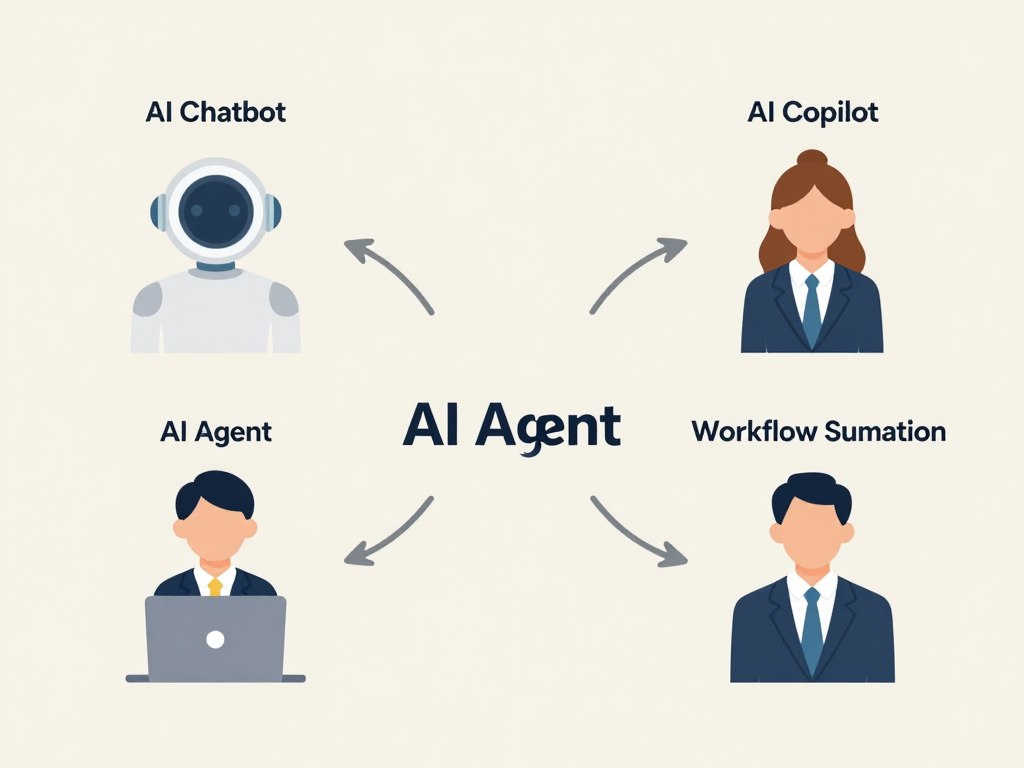
An AI chatbot may answer customer questions from approved content. An AI agent may also authenticate a user, retrieve account data, update a record, change a subscription, issue an authorized refund, or trigger an external workflow. Those actions depend on integrations, permissions, guardrails, and vendor configuration.
An AI copilot supports human agents with suggested replies, summaries, translation, intent detection, and recommended content. It does not independently resolve the customer interaction. Rules-based automation and machine learning classification can improve routing without being generative AI or agentic AI.
What to Look for in AI Customer Service Software
Automated resolution and human escalation
Ask what the vendor counts as an automated resolution. A useful definition is a customer request resolved by the AI agent without escalation to a human agent. Confirm whether a reopened ticket, partial answer, or agent handoff counts as a resolution.
Knowledge base quality
Generative AI customer service depends on accurate source content. Review article ownership, approval workflows, source citations, version control, localization, and fallback behavior when the AI cannot find a reliable answer.
Actions and authentication
Answers alone may not reduce service work. Determine whether the platform can authenticate customers, retrieve order or account data, update records, issue refunds where authorized, change subscriptions, and trigger workflows through a secure API.
Channels and customer context
Compare email, live chat, messaging, voice, SMS, WhatsApp, social messaging, and help center coverage. Confirm whether the same customer context follows the conversation across channels.
Pricing and usage control
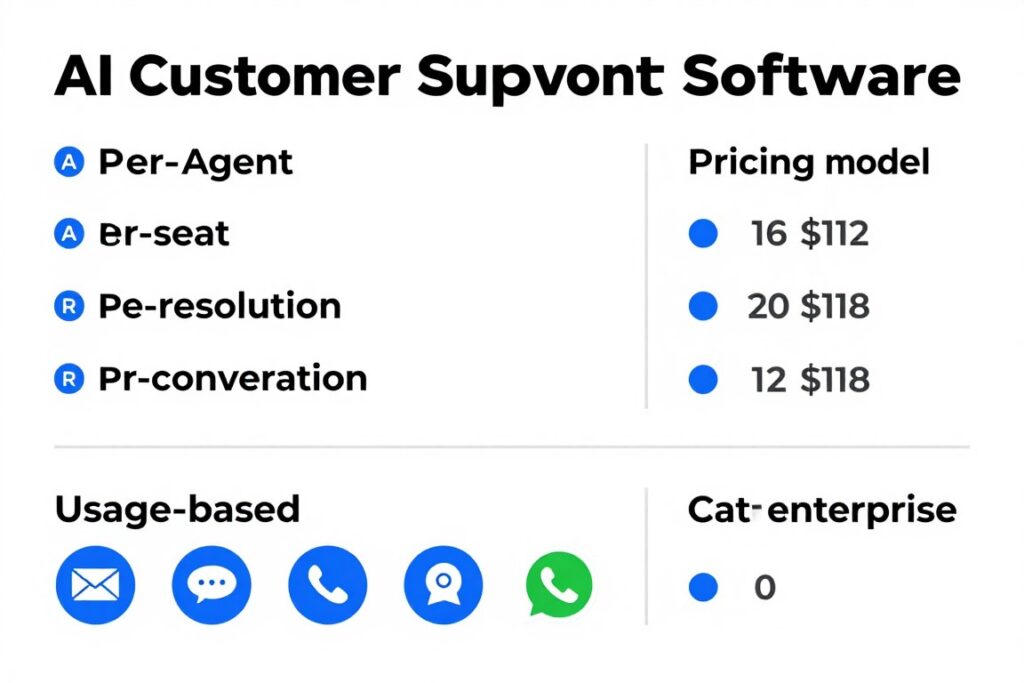
Model expected agent seats, ticket volume, conversation volume, automated resolutions, AI credits, phone minutes, storage, add-ons, implementation, and renewal terms. A low license price can become expensive when usage charges and premium channels are included.
Need a buyer-ready shortlist?
Compare your ticket volume, channels, integrations, and governance needs before scheduling a sales conversation.
Zendesk — Best Overall AI Customer Support Software
Best for
Zendesk is best for established support organizations, multichannel operations, ticket-centric teams, and companies scaling human and AI service together.
AI Agent
Zendesk’s AI Agents and Resolution Platform are designed to answer customer questions and, when configured, use actions to support more complete resolution. Agent Builder and Action Builder are relevant when the team needs controlled workflow execution rather than answers alone.
Copilot
Copilot can support human agents with suggested replies, summaries, knowledge retrieval, and other productivity features. Confirm the exact features in the purchased package and region.
Ticketing
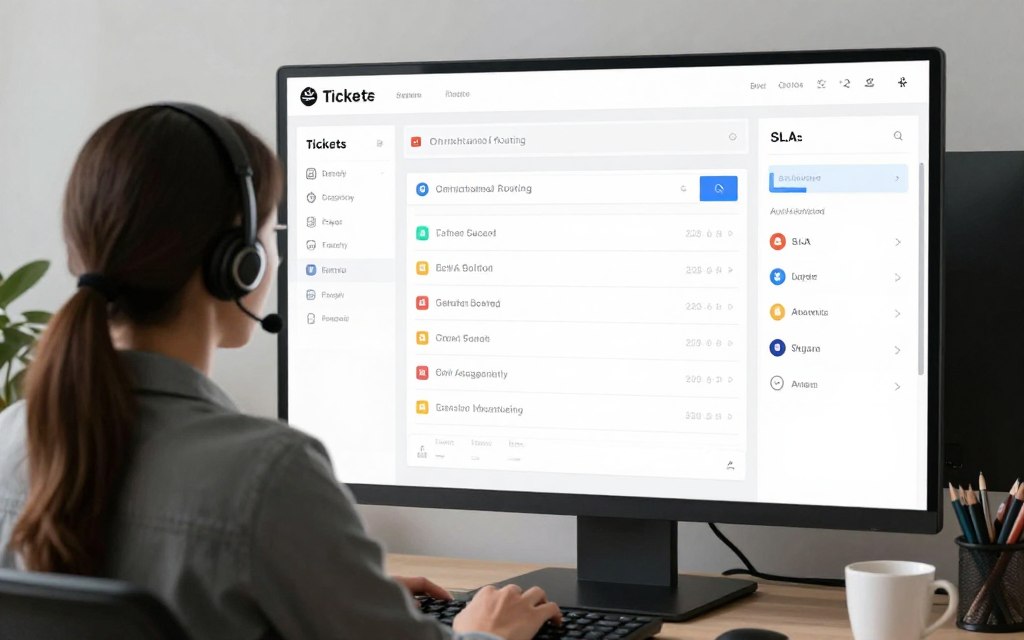
Ticketing, business rules, automations, SLAs, customer context, and reporting make Zendesk a strong AI-powered help desk for structured service operations.
Omnichannel
Suite packaging can include messaging, live chat, email, voice, routing, and other channels. Verify whether telephony, SMS, WhatsApp, and social messaging are included or priced separately.
Automation
Rules, triggers, macros, routing, and AI ticket automation can work together. Do not count ordinary workflow rules as autonomous AI resolution.
Knowledge
Knowledge supports help center content and AI retrieval. Governance should cover article approval, outdated content, source quality, multilingual support, and escalation when confidence is low.
Pricing
Published annual prices have included approximately $19 per agent per month for Support Team, $55 for Suite Team, and $115 for Suite Professional, but these figures and packaging must be verified immediately before publication.
Zendesk is moving toward outcome-based AI pricing in which AI Agent usage is measured through automated resolutions. Zendesk introduced new automated-resolution tiers in May 2026. Automated resolutions should not be confused with AI usage allowances or agent licenses.
Integrations
The marketplace, API, customer context, and enterprise administration are major strengths. Review authentication, CRM synchronization, data retention, audit logs, role controls, and integration ownership before deployment.
Pros
- Mature ticketing and omnichannel service
- Strong ecosystem and API
- Broad automation and governance options
Cons
- Pricing becomes more complex with AI usage and add-ons
- Higher tiers can become expensive
- Advanced functions may require additional products
- Configuration becomes involved at scale
Bottom line
Zendesk is the strongest general recommendation when a business needs mature customer support software and a path from agent assist to controlled AI agent resolution.
CTA
Evaluate Zendesk for your service operation
Review current Suite packaging, automated-resolution terms, channels, integrations, and governance requirements.
Intercom + Fin — Best AI-First Customer Support Platform
Best for
Intercom fits SaaS, mobile, and digital businesses that prioritize conversational support, product education, proactive messaging, and Fin AI Agent.
AI agent and chatbot
Fin is positioned as an AI agent rather than only a scripted customer support chatbot. Its practical scope depends on knowledge sources, connected systems, permissions, and escalation rules. Verify whether the required action can be completed or only explained.
Inbox and ticket operations
Intercom combines conversations, inbox workflows, tickets, routing, reporting, and customer context. It may suit conversation-led teams better than organizations that require highly elaborate legacy ticket structures.
Knowledge and automation
Fin depends on help center and approved content. Teams should test accuracy against real customer questions, edge cases, multilingual support, and unclear requests.
Pricing and implementation
Intercom pricing commonly combines seats, plan tiers, and Fin usage or outcome terms. Verify whether charges are per seat, per resolution, per conversation, or based on another usage measure.
Strengths and limitations
Pros
- Strong AI-first positioning
- Good fit for product-led digital support
- Conversation and customer context in one workspace
Cons
- Usage pricing requires careful modeling
- Not every complex ticket operation is equally natural
- Action depth depends on integrations
CTA
Explore Fin for AI-first support
Test representative customer questions and map the integrations needed for authenticated actions.
Freshdesk / Freshworks — Best Value AI Customer Support Software for SMBs
Best for
Freshdesk is a practical choice for SMB and mid-market teams seeking ticketing, knowledge, automation, reporting, and AI support software without starting with a complex enterprise program.
Freddy AI capabilities
Freshworks’ Freddy capabilities can support answer generation, ticket classification, summaries, suggested replies, knowledge retrieval, and customer service automation. Confirm which features belong to the selected Freshdesk or Freshworks package.
Help desk and channels
Freshdesk supports structured tickets, email, routing, SLAs, workflows, knowledge, and selected messaging or live chat functions. Voice, WhatsApp, SMS, and social channels should be validated by plan.
Pricing and fit
Freshdesk is often considered a value option, but the real cost depends on agent seats, AI usage, channels, automation limits, and premium reporting. Verify current U.S. prices and the length of any free trial.
Strengths and limitations
Pros
- Accessible entry point for smaller teams
- Useful ticketing and workflow foundation
- AI features can support agent productivity
Cons
- Advanced functions may require higher plans
- Channel packaging needs close review
- Enterprise governance may need additional evaluation
CTA
See whether Freshdesk fits your budget
Compare seat pricing, AI allowances, channels, workflow limits, and upgrade requirements.
Salesforce Service Cloud + Agentforce — Best Enterprise AI Customer Service Platform
Best for
Salesforce fits enterprise service organizations with complex customer data, multiple business units, sophisticated workflows, and an existing Salesforce CRM investment.
Agentforce and customer service AI
Agentforce is designed for AI agents that can reason over approved data and take permitted actions through Salesforce and connected systems. The boundary between answering, recommending, and executing must be defined through permissions and testing.
Service operations
Service Cloud provides case management, routing, knowledge, service workflows, SLAs, analytics, customer context, and integration options. It is designed for broad service operations rather than a small team seeking a simple inbox.
Pricing and governance
Salesforce pricing can include user licenses, platform products, AI credits, usage, implementation, and custom enterprise terms. Confirm the commercial model in writing and evaluate data access, auditability, retention, identity, and human escalation.
Strengths and limitations
Pros
- Deep CRM context
- Strong workflow and enterprise administration
- Broad API and ecosystem
Cons
- Implementation can be complex
- Pricing may require a detailed business case
- Configuration and data governance demand specialist skills
CTA
Plan an Agentforce evaluation
Map customer data, permissions, workflows, AI actions, and escalation rules before requesting an enterprise proposal.
HubSpot Service Hub — Best for CRM-Integrated Customer Support
Best for
HubSpot Service Hub is a strong fit for companies that want customer service software connected closely to sales, marketing, customer records, and lifecycle reporting.
AI and customer context
HubSpot AI features can assist with drafting, summarization, knowledge, routing, and customer interactions. Confirm the current customer agent capabilities, action permissions, and plan requirements before treating the product as autonomous resolution software.
Ticketing and help center
Service Hub provides ticketing, shared inbox functions, live chat, knowledge base options, workflows, reporting, and CRM-based context. Teams should test whether the required SLAs, queues, and escalation paths are available at the selected tier.
Pricing and fit
HubSpot pricing varies by hub, seat, tier, onboarding, and usage. A lower entry price may not include enterprise service controls, advanced automation, or the reporting depth required by a large support organization.
Strengths and limitations
Pros
- Strong connection between service and CRM data
- Useful for growing revenue and support teams
- Familiar workflow and reporting environment
Cons
- Advanced service features can require higher tiers
- AI action depth varies by feature and integration
- Large service teams should test operational scale
CTA
Connect support with your CRM
Review Service Hub features, customer agent availability, seats, automation, and reporting needs.
Gorgias — Best AI Customer Support Software for Ecommerce
Best for
Gorgias is built for ecommerce brands that need customer conversations connected to orders, shipping, returns, subscriptions, and store systems.
AI customer service agent
Gorgias AI can support common ecommerce questions and, where authorized integrations permit, help with store-related actions. Verify whether the selected plan can retrieve order data, update subscriptions, start a return, or issue a refund, and identify which actions still require human intervention.
Ticketing and channels
The platform combines ticketing, shared inbox, live chat, email, ecommerce context, macros, routing, and automation. Confirm the required social, SMS, WhatsApp, voice, and marketplace channels before purchase.
Pricing and volume
Ecommerce support pricing may depend on seats, tickets, conversations, AI usage, or automated resolutions. Model seasonal conversation volume rather than relying only on the base monthly price.
Strengths and limitations
Pros
- Strong ecommerce context
- Useful store-related workflows
- Good fit for repetitive order questions
Cons
- Less general-purpose for complex enterprise service
- Usage pricing needs seasonal modeling
- Non-commerce workflows may need integrations
CTA
Test Gorgias with real store questions
Use order, shipping, return, and subscription scenarios to validate AI actions and escalation.
Ada — Best Enterprise AI Agent Platform for Customer Experience
Best for
Ada is aimed at large enterprises that prioritize an AI agent layer for customer experience across complex journeys and connected systems.
Agentic customer service
Ada should be evaluated on the actions it can perform in the buyer’s environment, not only on its ability to generate text. Test authentication, account lookup, workflow execution, record updates, escalation, multilingual support, and failure handling.
Knowledge and integrations
Enterprise AI agents need controlled knowledge sources, integration permissions, audit trails, analytics, and clear ownership. Confirm how Ada connects with ticketing, CRM, commerce, identity, and contact center systems.
Pricing and implementation
Ada is generally an enterprise evaluation rather than a simple self-serve purchase. Ask for a complete commercial model covering implementation, usage, automated outcomes, integrations, support, security review, and renewal terms.
Strengths and limitations
Pros
- Specialized AI agent focus
- Suitable for complex customer experience programs
- Can complement existing service software
Cons
- Custom pricing and discovery are likely
- Requires strong integration and governance planning
- May not replace a complete help desk by itself
CTA
Assess Ada for enterprise AI resolution
Define the journeys, systems, permissions, knowledge sources, and human escalation rules the AI agent must support.
CTA Analysis of Ranking Pages for This Keyword
Freshworks
The Freshworks result is positioned close to a product category and is likely directed at B2B buyers with an active software need. Its commercially useful CTA pattern is product exploration, trial, demo, or contact. The best placement is near the opening value proposition and again after capabilities or pricing.
Yuma
The Yuma result is a comparison-style educational article. Its visitors are colder than direct product-page visitors, but they have clear commercial intent. Native links inside product explanations and a low-friction product CTA are more suitable than an immediate aggressive sales form.
Helpshift
The Helpshift result focuses on AI chatbot customer service education. Its likely audience includes digital product, mobile, and support leaders. A useful CTA should connect the educational problem to a practical next step, such as reviewing the platform, requesting a demo, or evaluating automation readiness.
Common patterns
- Product-led pages use direct exploration, trial, or demo actions.
- Educational pages work best with contextual links after a problem or use case is explained.
- B2B visitors respond better when the CTA states what happens next.
- Long comparison pages benefit from multiple product-specific CTAs.
- Enterprise buyers need consultation language, while SMB buyers often prefer trial or pricing language.
Implementation Plan for AI Customer Support Tools
- Define the service baseline. Measure ticket types, conversation volume, resolution time, escalation rate, channel mix, and knowledge gaps.
- Choose safe use cases. Start with repetitive customer questions, status requests, policy explanations, and agent summaries.
- Prepare the knowledge base. Remove duplicate articles, assign owners, add approval dates, and document exceptions.
- Connect systems carefully. Map identity, CRM, order data, subscriptions, payments, and ticket updates before granting action permissions.
- Design human escalation. Define confidence thresholds, sensitive topics, complaints, legal issues, authentication failures, and service recovery rules.
- Run a controlled pilot. Compare AI answers with approved answers and review incorrect, incomplete, or overconfident responses.
- Measure business outcomes. Track automated resolution, recontact, escalation, agent acceptance, quality, customer satisfaction, and cost per interaction.
Knowledge-base readiness
A weak knowledge base limits every AI support platform. The implementation team should maintain a source-of-truth process and test customer questions that use informal language, missing context, and multiple languages.
Human intervention
Human agents remain important for judgment, empathy, exceptions, complaints, regulated topics, and complex account changes. Automation should make escalation clearer, not hide it.
AI Governance, Security, and Administration
Permissions and data access
Use least-privilege access for AI agents, workflows, APIs, and external actions. Separate read access from write access, and require stronger controls for refunds, cancellations, payment changes, and account ownership.
Quality assurance
Review a sample of automated conversations. Test hallucination risk, outdated policies, unsupported promises, tone, multilingual support, escalation behavior, and customer authentication.
Reporting
Ask whether reports separate AI answers, AI-assisted answers, automated resolutions, escalations, reopened tickets, and human-only tickets. Blended reporting can make automation appear stronger than it is.
Contracts and compliance
Review data processing, retention, model training, regional storage, access logs, breach notification, subprocessors, deletion, and audit obligations with the security and legal teams.
Do not approve an AI customer service agent for high-impact actions until identity, authorization, logging, rollback, and human escalation have been tested in realistic scenarios.
How to Shortlist the Right Platform
Choose Zendesk or Freshdesk
Prioritize a mature help desk, ticketing, routing, knowledge, SLAs, and a practical path to customer support automation.
Choose Intercom or HubSpot
Prioritize digital conversations, CRM context, product-led support, lifecycle data, and integrated customer interactions.
Choose Salesforce, Gorgias, or Ada
Choose Salesforce for enterprise complexity, Gorgias for ecommerce operations, or Ada for an enterprise AI agent program.
Buyer questions
- What is the exact unit of AI pricing?
- What does the vendor call a resolution?
- Can the AI take authorized actions or only provide answers?
- Which channels and integrations are included?
- How are human agents notified and supported?
- What knowledge, identity, and security work is required?
- Which features require premium tiers or professional services?
FAQs About AI Customer Support Software
What is AI customer support software?
It is customer support software that uses generative AI, machine learning, automation, or AI agents to answer questions, classify tickets, assist human agents, retrieve knowledge, route work, and sometimes complete authorized actions.
What is the best AI help desk for most businesses?
Zendesk is the strongest overall choice when a business needs mature ticketing, omnichannel service, integrations, knowledge, routing, reporting, and a path toward AI agent resolution.
Is an AI chatbot the same as an AI agent?
No. A chatbot may answer questions. An AI agent can be connected to systems and authorized to retrieve data, update records, trigger workflows, or resolve requests without human intervention.
How should AI support software be priced?
Compare the full model. Costs may include agent seats, platform licenses, AI credits, conversations, tickets, sessions, automated resolutions, voice minutes, integrations, add-ons, implementation, and custom enterprise terms.
Does AI eliminate human agents?
It usually changes the work rather than eliminating every human role. Human agents remain essential for exceptions, sensitive issues, judgment, complaints, quality review, and complex customer relationships.
Final Verdict: The Best AI Customer Support Software in 2026
Zendesk is the best overall recommendation for established teams that need a mature help desk, broad channels, ticket operations, knowledge, routing, reporting, and a credible path from copilot assistance to AI agent resolution. Intercom is the strongest AI-first option for SaaS and digital businesses. Freshdesk is a practical value choice for SMB and mid-market organizations.
Salesforce is better suited to complex enterprise service operations with deep CRM requirements. HubSpot is compelling when support must share context with sales and marketing. Gorgias is the focused choice for ecommerce brands, while Ada is most relevant to large organizations building a specialized enterprise AI agent program.
The best purchase depends on the action the AI must perform, the quality of the knowledge base, the required channels, the maturity of integrations, the level of human intervention, and the complete pricing model. Shortlist two or three platforms, test real customer questions, verify current packaging, and measure automated resolution without sacrificing accuracy or customer trust.
Make your next evaluation evidence-based
Compare the platforms against your real tickets, workflows, channels, security requirements, and customer experience goals.